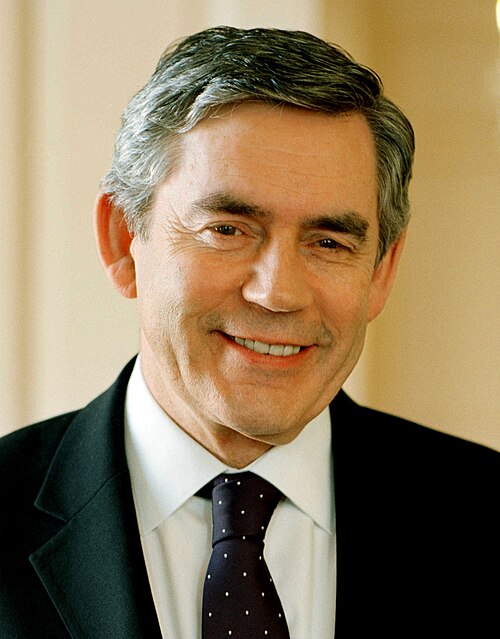

Our exclusive revelations about Gordon Brown call PM’s judgement into question… for last time?
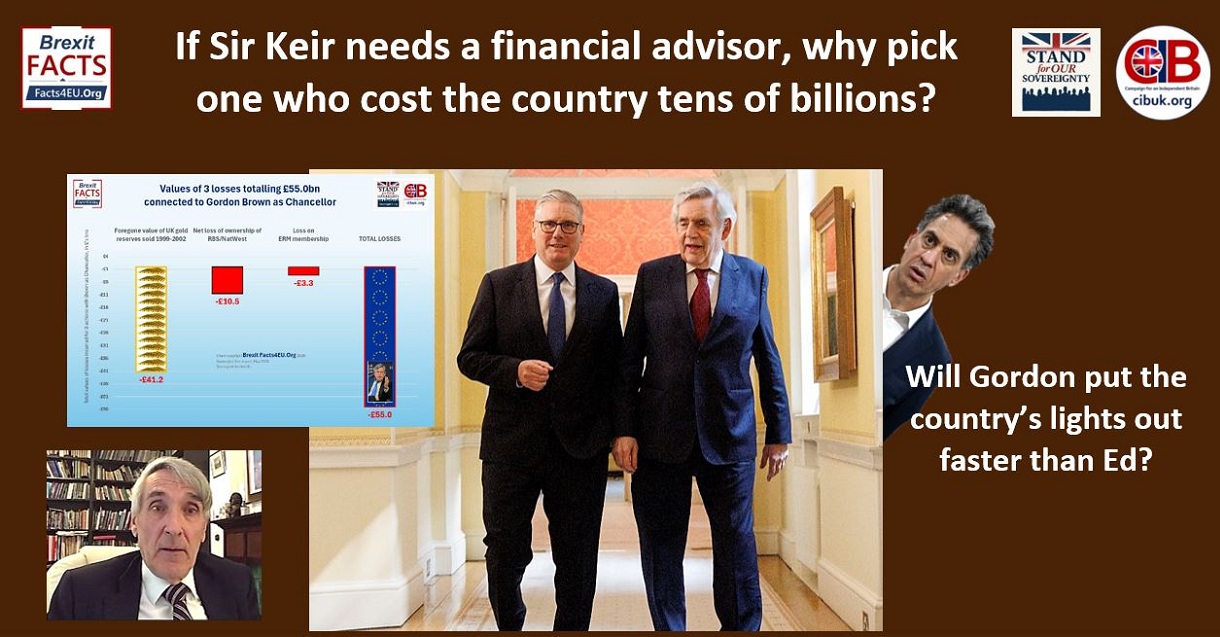
Montage © Facts4EU.Org 2026
In office, Brown lost us £50 bn, out of office he backed a disastrous EU scheme that plunged us into recession
With Sir Keir’s flailing record, how can bringing back a dinosaur with a decidedly dubious track record which includes losing over £50 bn of taxpayers’ money on EU-related projects possibly rescue his Premiership, and – more importantly – make our lives better?
The three facts we reveal about Gordon Brown in this report for the first time in quantified form – exclusively to GB News – are deeply shocking. After reading about these three disastrous episodes in which Mr Brown was deeply involved, the news that this man is now our Prime Minister’s financial advisor should fill us all with dread.
The following research was produced by Facts4EU in collaboration with Stand for Our Sovereignty and The Campaign for an Independent Britain (CIBUK.Org).
Gordon Brown? Seriously?
When Sir Keir Starmer announced he was bringing Gordon Brown back into government as his ‘Special Reviewer on Global Finance and Cooperation’, (and Harriet Harman in a different role), the response among many Labour MPs was bafflement, according to the BBC.
“It’s a joke. There is no question to which bringing these two back is the answer.”
– Anonymous ‘loyal’ minister, reported by the BBC, 09 May 2026
A former Conservative Minister, the Rt Hon the Lord Redwood, had his own disparaging comment about Mr Brown:
“Gordon will be a very useful investment adviser as long as Keir remembers to do the opposite. Infallibly wrong.”
– Lord Redwood, speaking to Facts4EU and GB News, 20 May 2026
1. Gordon Brown’s “golden touch”
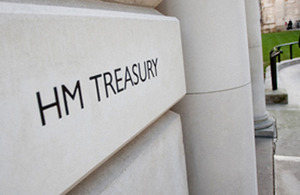
On 07 May 1999, the price of gold stood at US$282.40 per oz. This was the lowest it had been for 20 years. On that day, on the instructions of Gordon Brown, HM Treasury announced its intentions to sell part of the UK’s gold reserves – at the bottom of the market..
HM Treasury advance notice to markets
“To sell 125 tonnes of gold, 3% of the total reserves, during 1999-2000, with the Bank of England conducting five auctions on the Treasury’s behalf.”
“Detailed plans for auctions in 2000-01 and later years will be announced nearer the time…”
– Announcement by HM Treasury, 07 May 1999
Unsurprisingly, dealers started ‘shorting’ gold, resulting in the price falling further and the dealers making a lot of money. As a result, the UK sold at an even lower price than existed at the time of the announcement.
Here is what happened
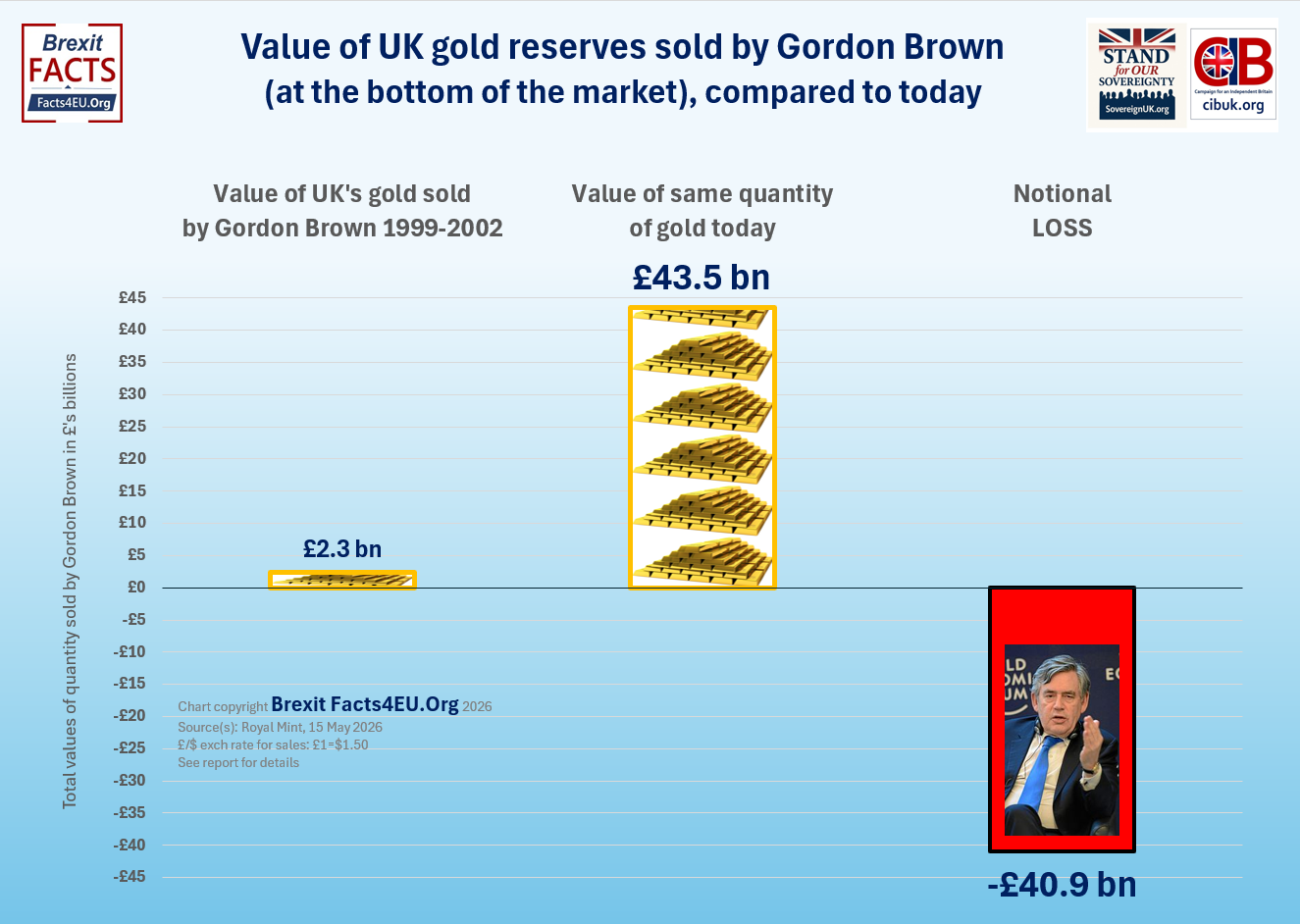
On 15 May 2026 when Facts4EU started work on this report, the price of gold was $4,624.39 per troy oz. Today, the bullion Gordon Brown sold would be worth £40.9 billion more than he sold it for.
Facts4EU has researched the results of all 17 auctions. Between July 1999 and March 2002 the Bank of England, acting for HMT, sold a total of 12,712,000 troy oz of gold. The average price achieved was just under US$275 per troy ounce, raising only c. £2.3 billion GBP (US$3.5 bn).
Value of the gold when sold by Mr Brown versus its value today (May 2026)
© Brexit Facts4EU.Org 2026 – click to enlarge
[Source(s) : Royal Mint]
As for the £2.3 billion proceeds from the sales, Mr Brown used around 40% to buy euro-denominated assets to show the EEC his support for their new euro. He was an advocate of the currency but he could scarcely have thought of a more costly way to show this. The Midas touch, this was not.
2. Mr Brown the Bank Manager and Share Dealer
Having clearly enjoyed his time as a gold bullion trader, some years later Gordon Brown became a banker. Whilst this was as a result of the banking crisis as a whole, Mr Brown had been a backer of the massive expansion of the Royal Bank of Scotland (RBS) which caused a very British problem.
RBS had made a huge EU acquisition of ABN Amro, which greatly overstretched its management and balance sheet, leading to its collapse. Scotsman Gordon Brown had supported this takeover, which created in effect a mega-bank with its HQ in Scotland, much to his liking.
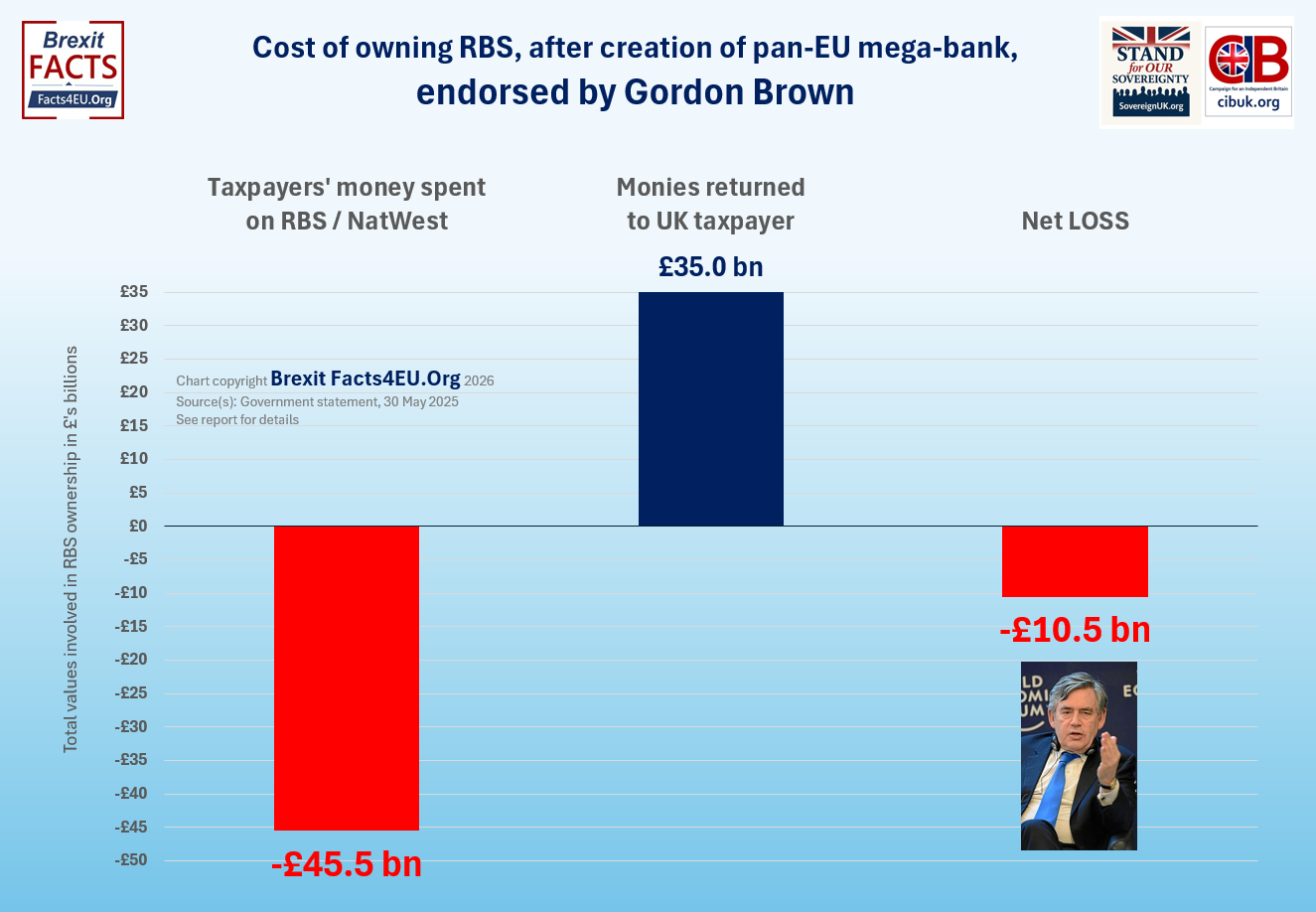
On its collapse, the taxpayer, via the UK Government and HM Treasury, became the majority shareholder of RBS in November 2008, taking a 58% stake. By December 2009 Mr Brown had taken the country’s total ownership of RBS to a whopping 84.4%. This cost the taxpayer a cool £45.5 billion in total.
Commenting exclusively to Facts4EU and GB News, the Rt Hon the Lord Redwood:
“Gordon Brown cost this country dear. Selling gold too cheaply to buy Euros and dollars to help the young European currency lost us billions of future gains.
“Backing RBS in a disastrous EU takeover which helped crash the bank saw him pay too much for shares to prop it up. Predictable large losses followed when later governments sold the shares.”
– Lord Redwood, 20 May 2026
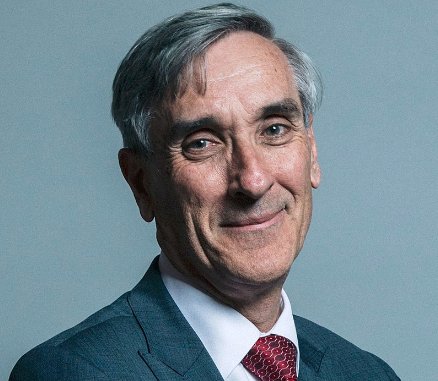
The losses – It fell to Rachel Reeves to announce them
It wasn’t until the summer of 2015 that the Government could start offloading some of these shares onto the private sector. It took 10 years (until 30 May last year, 2025) before HMT could announce it no longer held any voting shares in the Company.
The country lost £10.5 bn on selling the shares, and questions were raised about Mr Brown paying too much for the rescue.
RBS – taxpayer monies spent, monies returned, and overall loss
© Brexit Facts4EU.Org 2026 – click to enlarge
[Source(s) : HM Treasury]
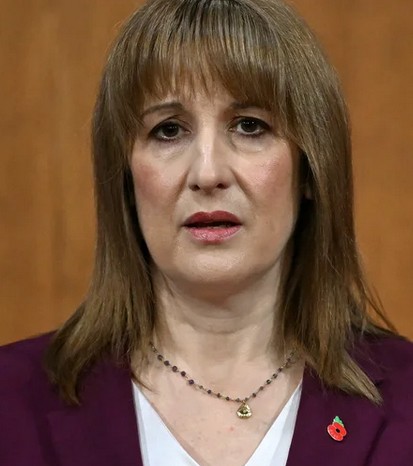
Rachel Reeves’ press release
We know the full amount of the losses incurred because the current Government finally admitted to them on 30 May last year in a press release.
Rachel Reeves had to announce the losses to the country
“Nearly two decades ago, the then Government stepped in to protect millions of savers and businesses from the consequences of the collapse of RBS.
“That was the right decision then to secure the economy and NatWest’s return to private ownership turns the page on a significant chapter in this country’s history.”
– Chancellor of the Exchequer, Rachel Reeves, 30 May 2025
This release goes on to state:
“Over 2008 and 2009, the government provided £45.5 billion to stabilise RBS (now NatWest)…
“To date, £35 billion has been returned to the Exchequer through share sales, dividends and fees. While this is around £10.5 billion less than the original support, the alternative would have been a collapse with far greater economic costs and social consequences.”
In short, the Government of Sir Keir Starmer confirmed the overall net loss on this episode was £10.5bn, which the taxpayer will never see back.
3. Finally, the losses on the European Exchange Rate Mechanism
Gordon Brown’s third expensive period for the taxpayer was when he was the keen advocate for the UK entering the EU’s Exchange Rate Mechanism (ERM).
This was created in 1979 and laid the foundation for the later Economic and Monetary Union (EMU) and the Euro. The UK joined the ERM in 1990 (and left in 1992) but obtained an opt-out from joining EMU in return for agreeing to the next major Treaty amendment, the Maastricht Treaty, in 1991. Readers will recall it was Maastricht that created the European Union (EU).
Whilst he was not Chancellor at the time the UK joined, Mr Brown had acted as its cheerleader and set the scene for ‘Black Wednesday’. The consequences are confirmed on Parliament’s website.
“After a flood of selling the pound on foreign stock exchanges, Britain was forced to leave the ERM in 1992, less than two years after joining. This day became known as ‘Black Wednesday’, costing the UK Treasury £3.3 billion.”
– Official UK Parliament website summary, last updated Apr 2013
The figure of £3.3bn is considered to be very understated by many commentators. This once again indicates the quality of advice today’s PM is likely to receive.
IN CONCLUSION:
3 actions by Sir Keir’s new ‘Special Reviewer on Global Finance and Cooperation’
led to 3 major losses, totalling £55 billion
Three big losses, all connected to Gordon Brown and the EU. These three financial catastrophes were never properly examined, as they were pro-EU, establishment-agreed policies.
- Wanting to own Euros rather than gold: -£41.2 bn
- Endorsing a large pan-EU bank with Scottish HQ: -£10.5bn
- Advocating that our economy be under EU monetary control: -£3.3 bn
- TOTAL: -£55.0 billion
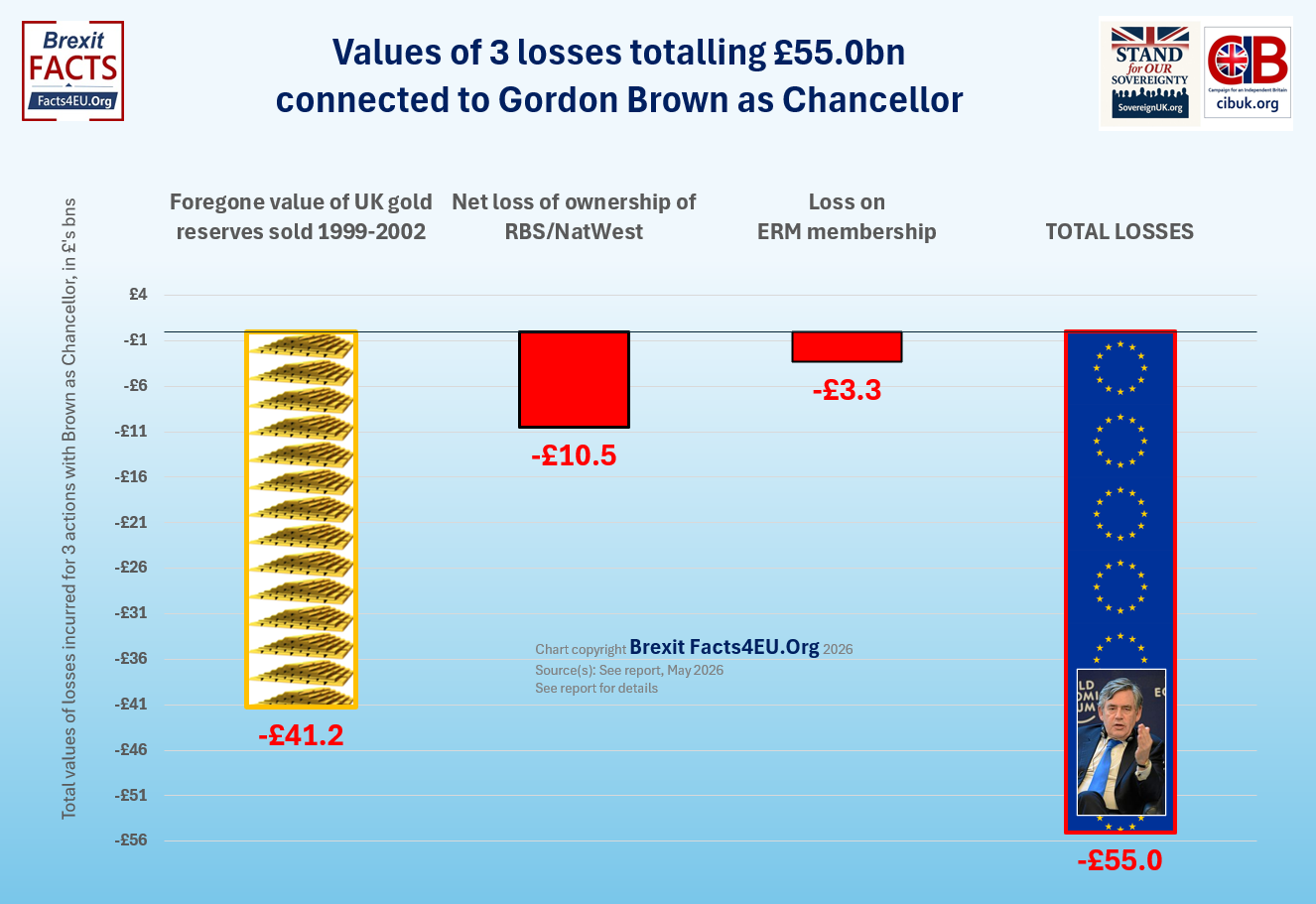
© Brexit Facts4EU.Org 2026 – click to enlarge
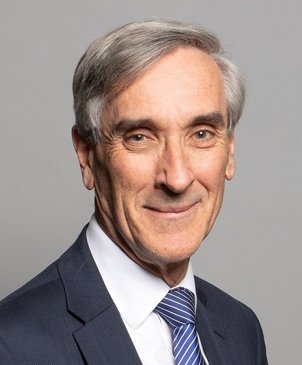
Lord (John) Redwood, former Secretary of State
commented exclusively to GB News and Facts4EU
“Far from saving the world, Gordon Brown backed policies which allowed and even encouraged banks to over-reach and then helped crash them with measures to curb the inflation caused.
“He was a strong proponent of the UK joining the ruinous European Exchange Rate mechanism, which brought us inflation, big losses and recession.”
“Whilst he was right to delay the UK ‘s entry into the Euro he did not rule out membership.
“His backing for buying Euros, expanding RBS more in Europe, and especially for the European Exchange Rate Mechanism disaster, imposed many EU losses on the UK.”
Observations
The whys and wherefores
Gordon Brown is the man Sir Keir has brought back into Government as his ‘Special Reviewer on Global Finance and Cooperation’ – a newly-created position.
The reactions of Labour MPs to Sir Keir’s unexpected decision are easy to understand. The experience Sir Keir is hoping to draw on is presumably that of Brown the Chancellor of the Exchequer, although this immediately begs the question of why, when the PM has his own Chancellor already in the form of Rachel Reeves.
The questions go much deeper than that, however
In this report we have provided evidence of the three major, expensive events for which Brown the Chancellor is most remembered. And Gordon Brown does not come out of any of them well. This only adds to the questions about the Prime Minister’s judgement.
With Gordon Brown always having been a pro-EU fanatic, even to the extent of wanting the UK to abandon the Pound and adopt the Euro, Sir Keir would have an ally if he were able to cling to power. It is clear his No.1 agenda now is to take the UK back into the EU, albeit under pretence and without officially declaring this.
The PM may feel that having an ardently pro-EU advisor will shore up his support among many Labour MPs. The problems arise when the track record of Mr Brown is examined. This report has summarised three catastrophic episodes which expose yet more questions for the reputation of Sir Keir and this Government, still not two years into its term of office.
Please, please help us to carry on our vital work in defence of independence, sovereignty, democracy and freedom by donating today. Thank you.
[ Sources: See above ] Politicians and journalists can contact us for details, as ever.
Brexit Facts4EU.Org, Thurs 21 May 2026
Click here to go to our news headlines
Please scroll down to COMMENT on the above article.
And don’t forget actually to post your message after you have previewed it!
Since before the EU Referendum, Brexit Facts4EU.Org
has been the most prolific researcher and publisher of Brexit facts in the world.
Supported by MPs, MEPs, & other groups, our work has impact.
We think facts matter.
Please donate today, so that we can continue to ensure a clean Brexit is finally delivered.
Any credit card user