EU’s claim of “Best of both worlds” is now in danger of looking the worst of all worlds
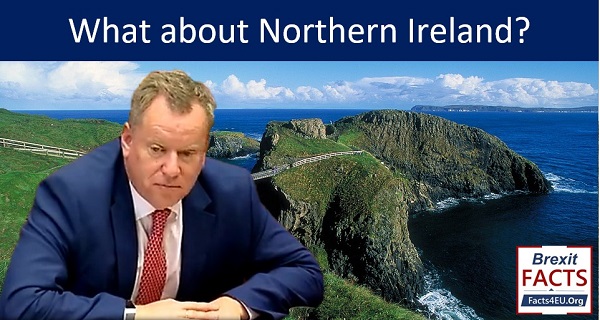
Montage © Facts4EU.Org 2021
Detailed economic report reveals significance of N.I. Protocol to the Province’s economy
A Fraser of Allander report from the University of Strathclyde estimates that as a result of the EU’s Protocol, Northern Ireland’s GDP will fall 2.6%, NI exports to GB will fall by 6.1%, and to the Rest of the World (ROW) by 8.6%.
The report goes on to say NI employment will be 1.25% lower, real wages will fall by 3.9%, and overall consumption will fall by 2.5% – all against expectations before the Protocol was introduced.
The first economic modelling of the impact of the Northern Ireland Protocol on the Province’s trade patterns suggests real harm is being done to internal NI-GB trade and there are no grounds to suggest Northern Ireland enjoys “the best of both worlds”, as currently suggested by the EU and in the past by Michael Gove.
Both the EU Commission and Mr Gove have made the “best of both worlds” claim as a result of Northern Ireland being part of the UK but inside the EU’s customs union and single market.
Pro-Remain body forecasts poor economic outcome for N.I., because of EU’s Protocol
The report comes from the University of Strathclyde’s Fraser of Allander Institute, which has previously produced economic projections favouring the case for the UK remaining in the EU.
Nevertheless, while the Institute’s position remains unchanged its latest estimates give no comfort to the EU, the Republic of Ireland, nor to other supporters of the Protocol. It dismisses the case for the Province’s current status providing an economic advantage to Northern Ireland as has consistently been claimed.
Its modelling suggests NI GDP will fall 2.6% – with mitigations to reduce the impact of the protocol unlikely to take the impact below a GDP fall of 1.7%. NI exports to GB are predicted to fall by 6.1% and to the Rest of the World (ROW) by 8.6%. Meanwhile NI employment will be 1.25% lower, real wages will fall by 3.9%, and overall consumption will fall by 2.5%, according to the predictions in the report.
All of this comes against the expectations over a nominal 15-year period compared to the period before the Protocol was introduced. On the trade position it estimates imports to NI businesses from GB falling by 5.9% while imports from the ROW increase by 0.5%.
Observations
It would be good to know the real figures rather than have modelled estimates but the most recent complete set of official figures available are for two years ago when Theresa May was still Prime Minister.
The only established economic fact around the Northern Ireland Protocol is that there are no economic facts to inform the debate. Despite deafening political noises, and claim and counter-claim, all actors are flying blind – relying on readings taken in the Republic of Ireland. By definition these cannot capture the necessary data to confirm the Protocol’s impact on where it is actually being applied – Northern Ireland.
The Fraser of Allander Institute report – which chiefly considers the impact of the Protocol’s non-tariff barriers – goes some way to informing the debate about what is happening on the ground. It blows out of the water the notion Northern Ireland is enjoying the “best of both worlds”.
While it suggests the best outcome would have been to have had no Brexit at all (not surprising, given the Institute’s past modelling) it cannot be ignored by advocates of the Protocol or defenders of the EU’s position that the findings of an economic institute that has repeatedly favoured remaining in the EU backs up the positions of the UK Government, opponents of the Protocol and Brexiteers still waiting on a real Brexit.
Given the mainland of Great Britain is Northern Ireland’s largest ‘export’ market it is beyond doubt that creating friction for trade within the UK must harm the economic performance of the province, notwithstanding the damage that it also inflicts to the tenets of the Belfast Agreement and other constitutional arrangements.
The lack of hard data is a failure of the Northern Ireland Office and must be rectified as a matter of urgency. Thus far the economic debate has, ironically, relied upon interim data being supplied by the Republic of Ireland – with the most recent Northern Ireland Statistics and Research Agency (NISRA) figures being from 2018/19 before the Protocol was introduced on 1st January 2020. By comparison Republic of Ireland statistics for imports and exports of goods are as recent as September 2021
Yet through this statistical fog there can be no doubt that economic damage is being done. We can see the lorries being turned away at Larne and Belfast – refused entry within their own country – because their paperwork does not meet the requirements of the EU’s customs rules. We also know from corporates such as M&S how this leads to food being dumped if it cannot reach a mainland market in enough time to be sold. And we know some product lines readily available across the rest of Great Britain are being deleted from sale by British supermarkets to try and overcome the obstacles and avoid profit-eating costs.
All of these outcomes happen under the temporary ‘grace period’ arrangements before the full impact of EU regulations are applied. It can only get far worse when the relaxations are no longer extended and the Protocol’s real impact is felt.
Establishing the true patterns of trade must be given the utmost priority, not just for justifying the unpicking of the disastrous Protocol but also for demonstrating the inseparability of the province from the rest of the UK. What has been especially missing is the data reflecting the impact upon the large majority of small and medium-sized NI businesses whose commerce is orientated towards GB and not the Republic.
The Fraser of Allander modelling gives us some insight as to how this might play out theoretically, albeit without factoring in the wider opportunities Brexit provides.
Lord Frost must take note: while the defence of Northern Ireland’s place in the UK is about much more than trade patterns, relying on NISRA economic statistics that are more than two years old is simply not acceptable in the digital age. Lord Frost’s colleagues in the Northern Ireland Office must close-up this information gap, not just to be able to defeat the Protocol but to defend the Union itself.
Facts4EU.Org needs you today
We are a ‘not for profit’ team (we make a loss) and any donation goes towards the actual work, not plush London offices, lunch or taxi expenses, or other luxuries of some organisations.
We badly need more of our thousands of readers to donate. Could this be you, today? Maybe you’ve been thinking about it, but just haven’t got around to doing it? If so, let us reassure you. It’s quick and easy and we use two highly secure payment providers. And we do NOT ask you for further donations if you donate once – we just hope that you keep supporting us. Your donation stays anonymous unless you tell us otherwise.
Please don’t assume that other people will keep us going – we don’t receive enough to survive and we need your help today. Could you help us?
Most of our readers are well-informed and appreciate our fact-based articles, presented in a way you won’t see anywhere else. If you value reports like the one above, please help our work with a donation. We have far more to do in researching, publishing, campaigning and lobbying Parliament than we have in terms of the financial resources to fulfil these tasks. We badly need funding to continue – we rely 100% on public donations from readers like you.
If you believe in a fully-free, independent, and sovereign United Kingdom, please make a donation now. It’s quick, secure, and confidential, and you can use one of the links below or you can use our Donations page here. You will receive a personal, friendly ‘thank you’ from a member of our team within 24 hours. Thank you for reading this.
[ Sources: University of Strathclyde – Fraser of Allander Institute ] Politicians and journalists can contact us for details, as ever.
Brexit Facts4EU.Org, Sat 11 Dec 2021
Click here to go to our news headlines
Please scroll down to COMMENT on the above article.
And don’t forget to actually post your message after you have previewed it!
Since before the EU Referendum, Brexit Facts4EU.Org
has been the most prolific researcher and publisher of Brexit facts in the world.
Supported by MPs, MEPs, & other groups, our work has impact.
We think facts matter.
Please donate today, so that we can continue to ensure a clean Brexit is finally delivered.
Any credit card user


Leave a Reply